The History of Ozone Therapy: From 19th-Century Discovery to Modern EBOO
What if one of the most researched tools in integrative medicine wasn’t new at all—but something conventional medicine quietly walked away from?
Medical ozone has been studied for well over a century, with early use in disinfection, wound care and infection control. Yet in the United States, it largely disappeared from mainstream medical practice.
Not because researchers found it ineffective.
But because of regulatory decisions made decades ago—decisions that are frequently misunderstood.
Meanwhile, countries including Germany, Italy, Russia, Spain and France kept studying it, refining delivery methods and developing formal medical societies around it.
Today, that century of research and refinement has culminated in advanced systemic approaches such as EBOO—Extracorporeal Blood Oxygenation and Ozonation. Here’s how medical ozone got from a 19th-century laboratory curiosity to where it stands today.
Quick Answer: Is Ozone Therapy an Old or New Treatment?
Medical ozone therapy is over 100 years old. It was first studied in the late 1800s and used clinically as early as World War I. U.S. regulatory attention shifted toward ozone’s dangers as an inhaled air pollutant in the 1970s, which slowed domestic research even though medical ozone therapy does not involve inhaling ozone gas. Countries such as Germany, Italy and Russia continued studying and refining ozone therapy throughout that period, and interest in the United States—including in advanced systemic approaches like EBOO—has been growing again in recent years.
What Is Ozone? (And Why It Matters)
Ozone (O₃) is a molecule made of three oxygen atoms—a highly reactive form of oxygen first identified in the 1800s by German chemist Christian Friedrich Schönbein.
Its defining property is reactivity: ozone interacts readily with biological material, and researchers believe this interaction triggers controlled oxidative signaling within the body.
That reactivity is also why medical ozone must always be administered by trained professionals using specialized equipment—it is not something to be handled casually.
The History of Ozone Therapy
Late 1800s: Early Discovery
The first ozone generators were developed in Germany in the late 19th century, initially used to disinfect operating rooms and sterilize surgical instruments.
Early 1900s: Medical Use Begins
Ozone’s medical applications were discussed in the medical literature as early as 1902, including use for tuberculosis and wound healing.
During World War I, ozone was used by field physicians to treat infected wounds and gangrene, a period frequently cited as a turning point for clinical interest in ozone.
Mid-1900s: Germany Leads the Way
Germany continued to develop modern ozone generators and clinical protocols throughout the 20th century.
Physician Hans Wolff published influential work on medical ozone and trained other physicians in its use, helping ozone become integrated into vascular, dental and surgical medicine in parts of Europe.
The United States: Early Adoption, Then Decline
Ozone generation even has a place in American innovation history—Nikola Tesla patented an ozone generator in 1896, and early American physicians experimented with ozone for infections and chronic illness in the early 20th century.
That early momentum did not continue.
Why Did the U.S. Pull Back in the 1970s?
In the 1970s, U.S. regulatory attention shifted toward air pollution and lung toxicity.
The U.S. Food and Drug Administration determined that ozone is toxic when inhaled and can damage lung tissue and cause respiratory irritation.
That determination is accurate—inhaling ozone gas is genuinely dangerous.
But an important distinction is often lost in that history:
Medical ozone therapy does not involve inhaling ozone.
Instead, medical ozone is delivered through controlled exposure involving blood, tissue or localized application—never the lungs.
Even so, the regulatory posture toward ozone as an air contaminant effectively slowed widespread U.S. clinical research for decades.
Reference: U.S. Food and Drug Administration, ozone-related device regulation, 21 CFR § 801.415. View the regulation
While the U.S. Stepped Back, Research Continued Worldwide
Ozone therapy did not disappear internationally—it simply moved.
Countries that continued active research and clinical use include:
- Germany
- Italy
- Russia
- Spain
- France
Germany alone is home to thousands of ozone practitioners and formal medical societies devoted to the subject. The Medical Society for the Use of Ozone in Prevention and Therapy was founded in 1972 specifically to advance research and clinical standards.
A 2025 historical review traces this international research arc in detail, from ozone’s earliest clinical use through its modern applications.
Research: Historical Highlights of Ozone Therapy. 2025. View the study on PubMed Central
What Does the International Research Show?
Decades of international study have explored medical ozone across several biological areas:
Antimicrobial Properties
Laboratory and clinical research has examined ozone’s interactions with bacteria, viruses and fungi, and ozone has historically been used in wound care and equipment sterilization.
Inflammation and Pain
Multiple clinical studies have investigated ozone therapy for chronic inflammatory and pain-related conditions, including its use alongside conventional care for lumbar disc herniation and related back pain.
Circulation and Oxygen Utilization
Research has explored ozone’s relationship to microcirculation and oxygen metabolism, including studies in vascular and ischemic conditions such as peripheral artery disease.
Wound Healing
Systematic reviews have evaluated ozone therapy for chronic wounds and ulcers, including diabetic foot ulcers, with several studies reporting improved healing outcomes.
Immune Modulation
Ozone has been studied for its potential to modulate immune signaling through controlled oxidative stimulation, an area of ongoing interest in infectious and inflammatory disease research.
Research: Ozone Therapy: A Clinical Review. Journal of Natural Science, Biology and Medicine. 2011. View the study on PubMed Central
Research: The Role of Ozone Treatment as Integrative Medicine: An Evidence and Gap Map. 2023. View the study on PubMed Central
These findings represent research interest and biological plausibility—not proof that ozone therapy cures or treats any specific disease. As with any therapy, the strength of evidence varies by condition and route of administration.
From Autohemotherapy to EBOO: How Ozone Delivery Has Evolved
Medical ozone is never inhaled. Over the past century, researchers and clinicians have developed several controlled methods of administration:
Insufflation
Rectal, vaginal or ear application intended to support systemic absorption through mucosal tissue.
Major Autohemotherapy (MAH)
A defined volume of blood is drawn, combined with a controlled ozone-oxygen mixture, and returned to the body. This is one of the most widely researched forms of systemic ozone therapy.
High-Dose Ozone (Multi-Pass)
An extension of MAH in which a larger volume of blood is processed, often across multiple passes, for a more intensive protocol.
EBOO (Extracorporeal Blood Oxygenation & Ozonation)
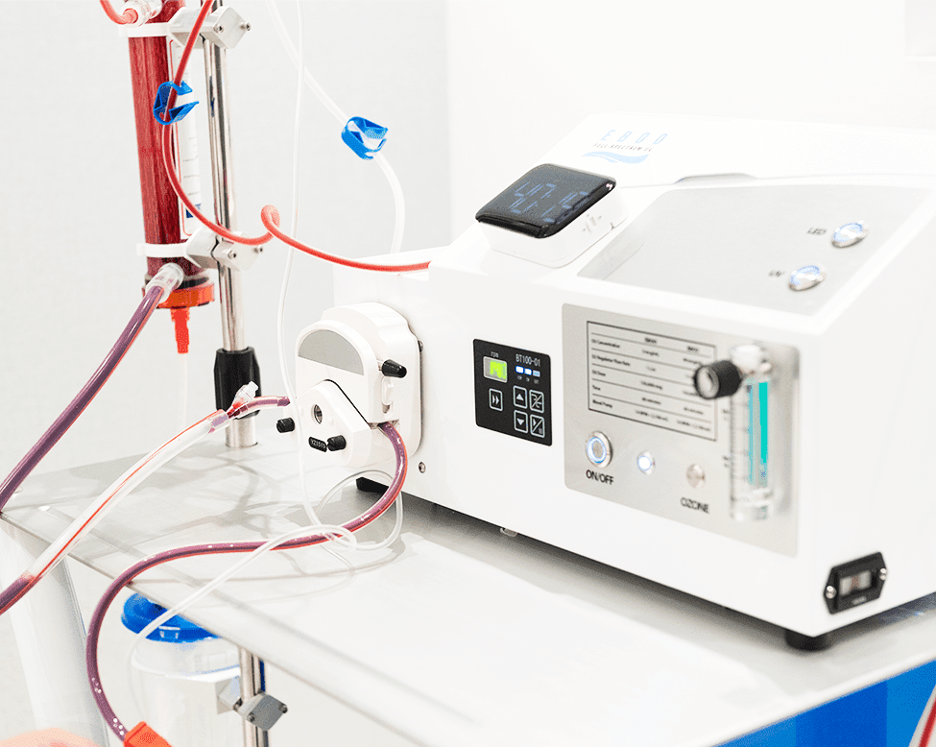
EBOO represents the most advanced evolution of systemic ozone delivery. Rather than treating a fixed volume of blood, EBOO continuously circulates blood through an external oxygenation-and-ozonation circuit before returning it to the body—allowing a substantially larger volume of blood to be processed during a single session.
Learn more: What Is EBOO Therapy?
Is Ozone Therapy Controversial?
Medical ozone sits at an interesting crossroads in modern medicine.
What we know:
- It has over a century of documented clinical use internationally
- It is supported by an expanding body of international research and formal medical societies
- It has shown promising results in multiple areas of study
What remains debated:
- Standardization of dosing and treatment protocols across studies
- Long-term safety data across every proposed application
- The availability of large-scale, U.S.-based randomized clinical trials
An important safety note:
- Ozone should never be inhaled under any circumstances
- Medical ozone must only be administered by appropriately trained professionals using medical-grade equipment
- Improper administration—particularly gas injection outside proper protocols—has been associated with serious complications
The Bottom Line: A Century-Old Therapy Finding New Relevance
Ozone therapy isn’t new, and it isn’t a passing trend.
It’s a therapy that much of the world never stopped researching, even during the decades when U.S. interest declined.
While the United States stepped back beginning in the 1970s, other countries continued studying, refining and integrating medical ozone into clinical practice—work that has directly informed today’s most advanced systemic approach, EBOO.
For anyone researching integrative and functional medicine options, understanding this history helps explain why ozone therapy is being taken more seriously in the United States today than it has been in decades.
Frequently Asked Questions
How old is ozone therapy?
Medical ozone therapy dates back to the late 1800s, with documented clinical use beginning in the early 1900s and expanding significantly during and after World War I.
Why did ozone therapy decline in the United States?
In the 1970s, U.S. regulatory attention focused on ozone as a lung-damaging air pollutant. That determination about inhaled ozone is accurate, but it is separate from medical ozone therapy, which is never administered by inhalation. The regulatory climate nonetheless slowed U.S. clinical research for decades.
Is ozone therapy legal and used elsewhere in the world?
Yes. Countries including Germany, Italy, Russia, Spain and France have continued researching and clinically using medical ozone therapy for decades, supported by formal medical societies such as the Medical Society for the Use of Ozone in Prevention and Therapy, founded in Germany in 1972.
Is inhaling ozone the same as medical ozone therapy?
No. Inhaling ozone gas is dangerous and can damage lung tissue. Medical ozone therapy uses controlled, specialized routes of administration—such as autohemotherapy, insufflation or EBOO—and never involves inhaling ozone into the lungs.
What is the difference between Major Autohemotherapy and EBOO?
Major Autohemotherapy treats a fixed, predetermined volume of blood before returning it to the body. EBOO uses continuous extracorporeal circulation, allowing a considerably larger volume of blood to be processed during a single session.
Is EBOO considered the most advanced form of ozone therapy?
EBOO is widely regarded as one of the most advanced systemic ozone delivery methods available because of its continuous blood-processing design, though “most advanced” does not mean it is the right choice for every person or condition. That determination should be made with a qualified provider.
Is ozone therapy FDA approved?
Ozone therapy should not be represented as an FDA-approved treatment for curing or treating specific diseases. Patients should discuss regulatory status, evidence, alternatives, benefits and risks with a qualified healthcare professional.
Is ozone therapy safe?
Safety depends heavily on proper training, sterile technique, appropriate patient screening and correctly calibrated medical-grade equipment. Ozone should never be inhaled, and treatment should only be performed by qualified, trained professionals.
Where can I learn more about EBOO therapy near me?
EBOONearMe.net provides educational information about EBOO, medical ozone therapy and providers offering advanced ozone therapies. Learn more about EBOO Therapy or find EBOO therapy near you.
Medical Research & References
Historical Highlights of Ozone Therapy. 2025. National Library of Medicine / PubMed Central
Ozone Therapy: A Clinical Review. Journal of Natural Science, Biology and Medicine. 2011. National Library of Medicine / PubMed Central
The Role of Ozone Treatment as Integrative Medicine: An Evidence and Gap Map. 2023. National Library of Medicine / PubMed Central
Ozone Therapy: Overview, Pharmacodynamics and Clinical Applications. 2017. National Library of Medicine / PubMed Central
U.S. Food and Drug Administration. Ozone-related device regulation. 21 CFR § 801.415
Medical Disclaimer: This article is provided for educational purposes only and is not intended to diagnose, treat, cure or prevent any disease. Medical ozone and EBOO should not replace appropriate medical evaluation or medically necessary treatment. Individual eligibility, potential risks and expected benefits should be discussed with a qualified healthcare professional.
In Health,
Ginger Delph
Founder & Owner | Core iV Health & Wellness Center
Advanced IV Therapy | Biohacking | Regenerative Wellness
📍 Herndon, VA
📞 1-866-426-7348
✉️ ginger@coreivtherapy.com
🌐 coreivtherapy.com
“Your health is your greatest asset. Invest wisely.”